
Fibre is having a moment. Scroll anywhere and someone is fibermaxxing — piling on as much fibre as a day can hold. The instinct is right — most of us eat far less than guidelines suggest: roughly 15 grams a day against targets of 25 to 38.
Where it goes wrong is the jump: 15 to 40 grams overnight is how people end up bloated, convinced fibre “doesn’t agree with them.” It usually isn’t the fibre. It’s the pace.
The comfortable way to increase fibre is to add about 3 to 5 grams at a time, pair every increase with more water, and give your gut one to three weeks to adjust. Here’s how I do it — fibre first, one step a week, on real days.
Why does fibre make me bloated?
Fibre makes you bloated because you don’t digest it — it travels to your large intestine, where gut bacteria ferment it and produce gas as they work. Add a lot of fibre quickly and the gas builds faster than your system can comfortably clear it, which is the stretched, heavy feeling.
It’s why the same food can bother you in week one and sit fine in week four: gut bacteria adjust to what you feed them, on their schedule, not yours. Bloating after a sudden change is normal mechanics, not a verdict on fibre. For the plainer science, my rundown of gut-health basics covers it without the textbook tone.
Is some bloating normal at first?
Yes — mild bloating and extra gas are common at first, and usually settle within one to three weeks as your gut bacteria adapt; after a big, sudden jump, closer to four.
When is bloating a reason to slow down?
Slow down whenever a step feels rough — that’s the Hold Rule below, and it’s part of the method. But bloating with real pain, bloating that worsens, or bloating still unsettled after a few steady weeks deserves a healthcare professional. With a digestive condition such as IBS or inflammatory bowel disease, personal guidance beats a general routine.
How much fibre do I actually need per day?
Most adults do well aiming for about 25 grams a day for women and 38 for men under 50 — roughly 14 grams for every 1,000 calories you eat. The average person gets only about 15 grams, so falling short puts you in the overwhelming majority.
| Daily fibre target | Under 50 | Over 50 |
|---|---|---|
| Women | 25 g | 21 g |
| Men | 38 g | 30 g |
Treat the target as a direction, not a deadline — reaching it over a month beats hitting it by Friday and quitting by Monday.
What does “fibre first” mean?
Fibre first means the fibre lands before — or at the very start of — the rest of the meal: a breakfast anchored in fibre, and vegetables or salad eaten before the starch at your main meal. It’s the same food you were going to eat anyway, in a calmer order.
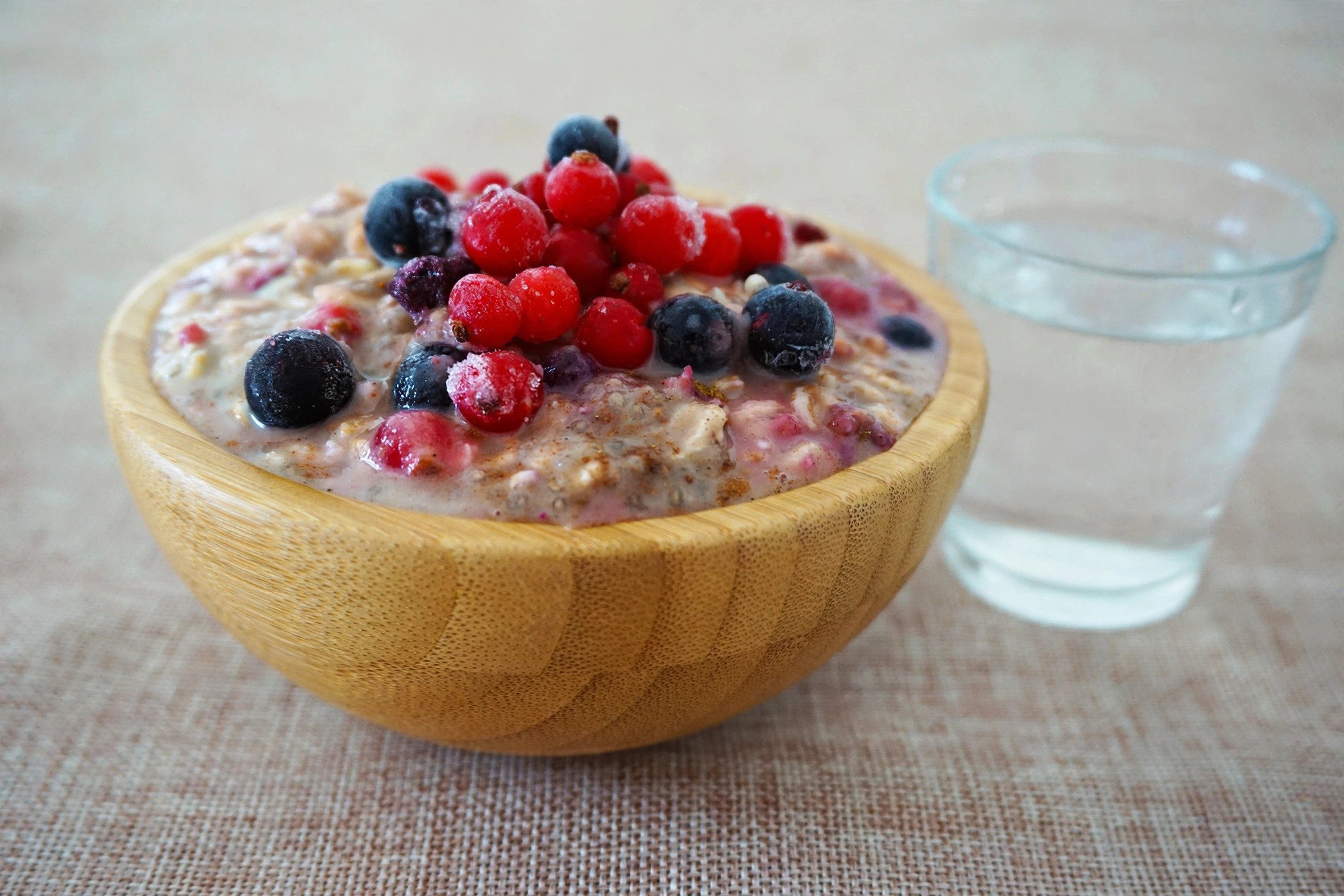
In my kitchen it’s two habits. Breakfast is built on fibre — oats, berries, a spoon of seeds — never fibre as an afterthought. At lunch or dinner, vegetables get eaten first, then protein, with bread, pasta, or potatoes last. (The same thinking runs through my morning routine.)

You may have seen fibre-first eating discussed for blood sugar. Small studies, mostly in people with type 2 diabetes, suggest eating vegetables and protein before carbohydrates may help steady the rise after a meal. Promising, not proven for everyone — my reason is simpler: fibre becomes the foundation of the meal instead of the garnish, and fullness arrives quietly before the plate is empty.
The 4-Week Gentle Ramp
Add roughly 3 to 5 grams of fibre per week — about one small change — and add a glass or two of water with each step. If a week feels rough, repeat it instead of pushing on.
Week 1 — Anchor breakfast. One fibre-first breakfast most days: oats with berries and a spoon of chia or ground flax — about 4 to 5 grams added. Water: one extra glass in the morning.

Week 2 — Spread it out. Add one fibre food at a second meal — lentil soup, a small portion of beans, a wholegrain swap. Water: a glass visible at meals.
Week 3 — Veg first at dinner. Vegetables or salad before the starch, most evenings.
Week 4 — Round out the day. Add a fibre snack — a pear, a handful of nuts, popcorn — or a second legume serving. Most people now sit near 25 to 30 grams a day.
The Water Rule
Every fibre step-up gets a water step-up. Fibre absorbs water as it moves through you; without fluid it can slow things down instead of helping — that’s how people trade bloating for constipation. One glass alongside each new fibre habit is the whole rule.
The Hold Rule
If bloating flares at any step, hold at the current level until it settles — a few days, sometimes a full extra week — then continue. Holding isn’t falling behind; it’s how the ramp works.
Which high-fibre foods are gentlest to start with?
Start with cooked, softer fibre — oats, cooked vegetables, berries, small portions of lentils or rinsed canned beans — before raw salads and heaped bean servings. Gentle first, ambitious later.
Friendly starting points, with rough fibre per serving:
- Lentils, ½ cup cooked — about 8 g
- Raspberries, 1 cup — about 8 g
- Pear, with the skin — about 5 to 6 g
- Oats, 1 cup cooked — about 4 g
- Chia seeds, 1 tablespoon — about 4 g
Two habits help: rinse canned beans, cook legumes until properly soft — and eat slowly, since swallowed air adds to the stretched feeling.
What’s the difference between soluble and insoluble fibre?
Soluble fibre dissolves in water and forms a gel — the kind in oats, beans, and many fruits, and the kind gut bacteria ferment most. Insoluble fibre doesn’t dissolve; it adds bulk, like bran and vegetable skins. Most plant foods carry a mix of both, so variety matters far more than categorising.
Where does gut support fit in?
Food, pace, and water do most of the work. Some people also keep a simple gut-support routine alongside the food changes — the order matters: food first, support second, only once the basics feel normal.
While habits change, the kindest things are the boring ones: more plant variety, fermented foods if you enjoy them, and not overhauling everything at once. My notes on natural binders cover the neighbouring territory. And if a daily product is part of your routine, a gentle gut-support supplement belongs after week 1 of the ramp feels ordinary — not before it, and never instead of it.
What is fibermaxxing — and should you try it?
Fibermaxxing is the trend of deliberately maximising fibre — and its instinct is right, since most of us genuinely eat too little. Where I part company is the scoreboard: extreme versions push 50, 70, even 90 grams a day — well past every guideline — and the predictable bloating gets blamed on fibre itself.
More is not automatically better — guidelines top out around 25 to 38 grams for a reason. Fibre first is the sustainable version: reach the sensible target gradually, and stay there.
Quick answers
Usually one to three weeks, as your gut bacteria adapt — closer to four after a big, sudden jump. If it isn’t easing by then, check in with a professional.
Yes. Very high intakes — especially sudden ones, or without enough water — can cause gas, cramps, and constipation or loose stools, and can interfere with absorbing some minerals.
Spread it out — a little at each meal beats one giant fibre-heavy sitting. Something fibrous early, something fibrous often.
Food first: it brings water, varied fibre types, and other nutrients with it, which no powder or capsule fully copies — and the habit lasts.
This article is general information only, not medical advice. If you have a digestive condition — IBS, inflammatory bowel disease, or a low-FODMAP plan from your clinician — talk to a healthcare professional before changing how you eat.
Fibre first. Ramp slowly. Water with every step. The one-page version is the matching Fibre-First Checklist pin on our Pinterest — and the ramp starts whenever your next breakfast does.
— Aria
Leave a Reply